
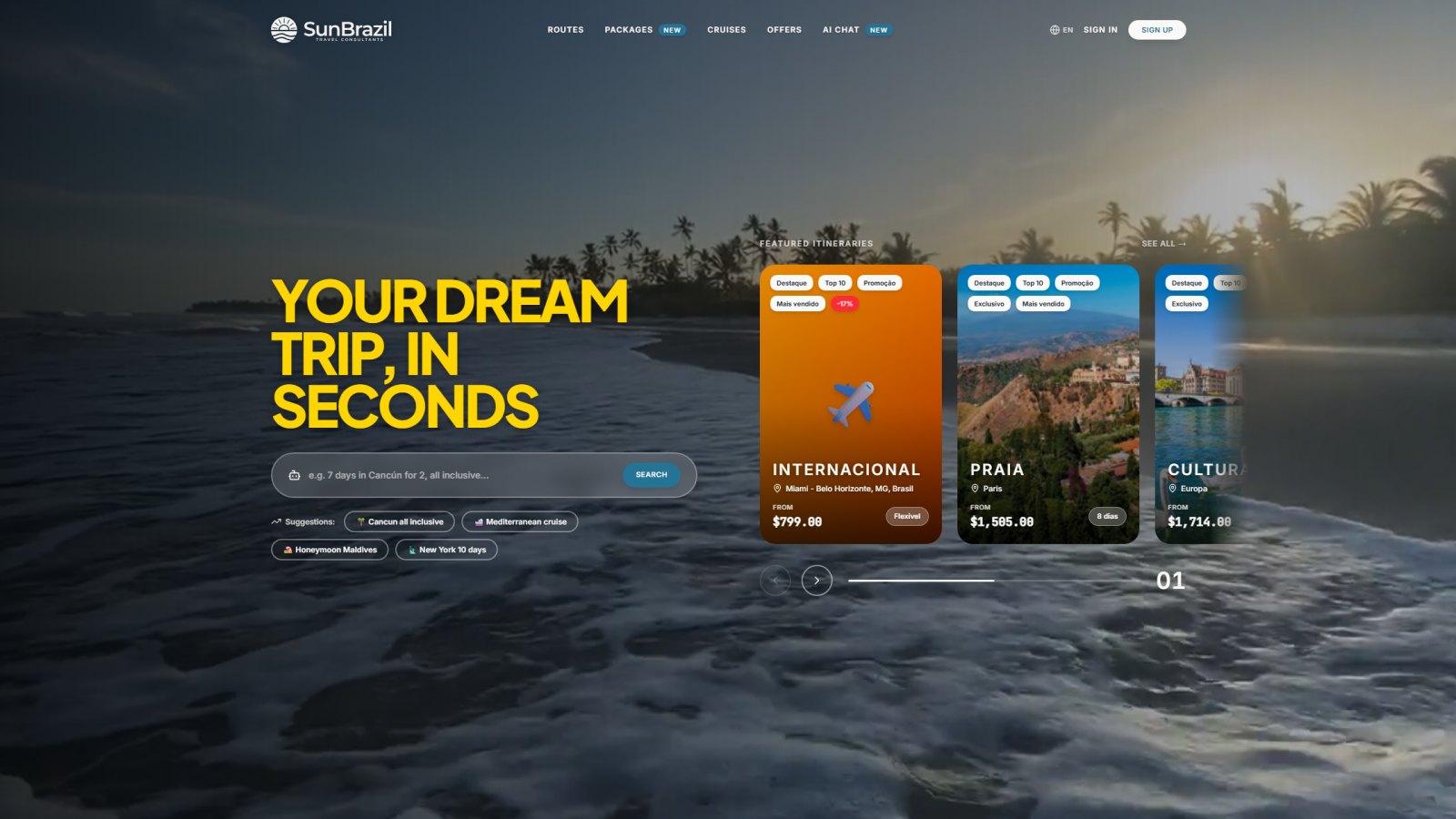
Sun Brazil — AI-Powered Travel Platform
I designed and built from scratch the new Sun Brazil digital platform, a travel agency with more than 30 years in the United States (Miami), serving both Brazilian and American audiences. The product replaces the dependency on third-party operators with an ecosystem of its own: a public sales site, a customer portal, a partner portal and a bespoke proprietary CMS.
Even with prior WordPress and Drupal experience — and no technical constraint against using them — the client chose a proprietary admin, ensuring full control over the data model, travel business rules, RBAC and direct integration with the AI layer.
Why this platform is different
This is not just an agency website: AI works on both sides of the operation.
- For the agency — automated administration: an automated mode (RPA) speeds up AI-assisted content administration — importing price tables (CSV/Excel) from operators, applying markup per category, registering and updating packages and routes, and organizing content, dramatically reducing manual work for the team.
- For the traveler — humanized self-service: end users search and assemble their products autonomously and quickly by chatting in natural language, and receive humanized responses generated by an LLM — always grounded in the real catalog, never inventing prices or policies.
It is this combination — automation for those who administer and intelligent conversation for those who travel — that sets the platform apart from a traditional e-commerce site.
AI applied to the product
- Self-service assistant: answers based on the agency's real catalog and institutional content (never inventing prices or policies), with anti-hallucination guardrails, rich formatting, real-time streaming and multilingual support.
- Multi-agent package orchestrator: coordinates agents, skills and tools (catalog, availability, vector search and recommendations) to assemble packages on demand, with RAG over institutional content + catalog, agent delegation and execution auditing.
- Runtime configuration: OpenAI-compatible providers (DeepSeek, OpenAI, Google), model and temperature per agent, adjustable by the admin.
Architecture
Three decoupled layers, scalable and independent per service:
- Frontend: Next.js 16 (App Router) + React 19 + TypeScript, a componentized design system (CVA + Tailwind Merge), Zustand, native i18n with 4 languages (pt, en, es, it) and 2 markets (BR / US, USD), with dynamic SEO and mobile-first layout.
- Backend: NestJS 11 + Prisma ORM + PostgreSQL 16 with pgvector, Redis 7 + BullMQ (cache and queues), JWT/Passport, Helmet, rate limiting, granular RBAC and auditing — 59 data models covering catalog, sales, CMS, AI, LGPD and partners.
- Dedicated AI service: Python + FastAPI with SSE streaming, an in-house RAG (embedder, indexer, retriever, pgvector client) and a tool registry (tool calling).
Infrastructure on a Linux VPS with Nginx, PM2 in cluster mode, Cloudflare and Let's Encrypt SSL, with DEV → PROD environments and versioned deploys.
Features
- Public site: discovery with highlights and offers, structured search with filters, package catalog and detail (gallery, day-by-day itinerary, inclusions, policies, reviews), comparison, a cruises module, destinations and routes, an AI chat with results beside the conversation, and commercial requests (form + notification).
- Customer portal: sign-up/login, email verification, password recovery, profile with travel preferences, travelers, favorites, price alerts and privacy/LGPD management.
- Partner portal: campaign dashboard and exposure/performance reports.
- Proprietary CMS: dashboard and operational view; full package CRUD with preview, categories, destinations, cruises, operators and origins; price-table import (CSV/Excel) with markup per category; orders, requests, quotes, coupons and finance; users and RBAC (Super Admin, Manager, Operator, Finance, Partner); policy library and notification templates; content and institutional pages; an AI hub (agents, skills and providers), auditing, LGPD and maintenance mode — all without third-party plugins.
AI in the development process
The project followed an AI-assisted, specification-driven workflow: PRD and technical spec as the source of truth, sprint execution with validation gates and documented handoffs. AI accelerated implementation, refactoring, design-system standardization and test writing, while validation was anchored in technical evidence: 49 automated API tests and an E2E suite with 23 passing scenarios, plus accessibility (WCAG 2.1 AA) and content audits.
Differentiators
- Bespoke proprietary CMS, no WordPress/Drupal — a strategic client decision with gains in performance, security and native AI integration.
- Three decoupled layers, scalable and independent per service.
- AI grounded in real, traceable data — not a generic chatbot bolted on top.
- Bilingual, dual-market (BR/US) operation from the foundation, ready for LGPD, auditing, async queues and vector search.
In one line: a full-stack travel platform with a proprietary CMS, package and cruise e-commerce, customer and partner portals, and an AI layer for self-service and package orchestration — built for a 30+ year American agency serving Brazilians and Americans.