
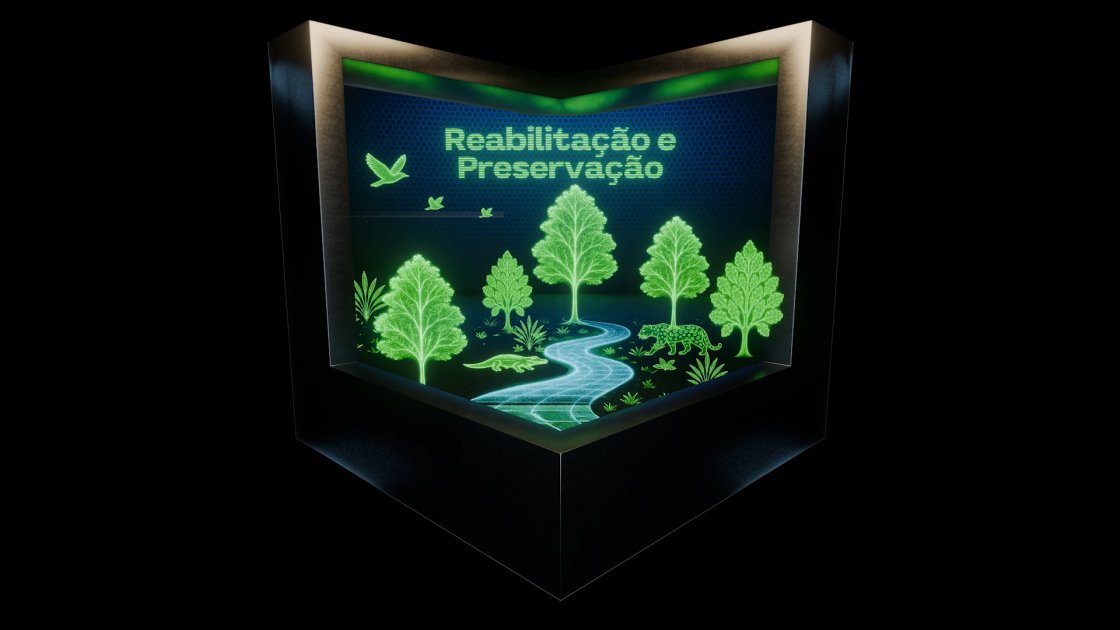
3D Anamorphic Projection – ABAL COP 30
1. Project Overview
The 3D Anamorphic Projection – ABAL COP 30 project was conceived as a high-impact visual experience for the ABAL – Brazilian Aluminum Association stand during COP 30, held in Brazil in 2025. My role was to transform complex technical information about the aluminum production process into an immersive and engaging visual narrative, capable of attracting, engaging, and educating the public in an environment of high international visibility and visitor traffic.
2. The Real Problem
In global events like COP 30, the challenge is not just to present data, but to capture attention in an environment saturated with information and visual stimuli. ABAL needed to communicate the innovation, sustainability, and precision of the aluminum industry, but traditional presentations of graphs and texts would not be enough to generate the desired impact. The risk was that the message would get lost in the noise, failing to position aluminum as a key material for a sustainable future. There was a clear need to break the mold and offer a memorable experience that was both didactic and visually spectacular, overcoming the limitations of static and unimmersive formats.
3. Insight and Strategy
My strategic diagnosis indicated that the solution lay not just in displaying content, but in creating an optical illusion that transformed the stand itself into a piece of communication. 3D anamorphic projection emerged as the ideal strategy for this purpose. Unlike conventional animations on flat screens, this technique creates a sense of extreme depth and volume, making objects appear to “jump” off the surface and physically integrate into the environment. The key decision was to prioritize visual impact and immersion, understanding that initial surprise and engagement would be crucial to retaining attention and, subsequently, facilitating the absorption of the message about aluminum production. We discarded simpler approaches for not delivering the level of differentiation and memorability that ABAL sought on such a relevant stage.
4. The Developed Solution
The solution consisted of a sequence of meticulously designed 3D animations to be displayed via anamorphic projection on a specific surface of the stand. The overall flow of the experience involved the visual representation of the stages of the aluminum production cycle – from sustainable bauxite mining to the final product and recycling – transforming complex industrial processes into a fluid and visually captivating narrative. Key components included detailed 3D models of equipment and materials, simulations of physical processes, and visual effects that explored the illusion of depth. The major differentiator was the ability to create a perception of "augmented reality" without the need for special glasses, where digital elements seemed to interact with the physical architecture of the stand, generating a "wow" effect that few traditional approaches could achieve.
5. Technologies Used (with Purpose)
The selection of tools was guided by the need for high visual fidelity, technical precision, and creative control over the anamorphic illusion:
- 3D Modeling and Animation: I used Blender as the primary tool. Its robustness in polygonal modeling, character animation (for interacting graphic elements), and physical simulations (fluids, particles to represent industrial processes) was fundamental. Blender's advanced rendering capabilities ensured the realism needed for the 3D illusion to be convincing.
- Composition and Post-production: Adobe After Effects was employed for the final composition of scenes, color adjustments, additional visual effects, and, crucially, for the precise synchronization of visual elements with audio and the stand's architecture. This ensured that the projection was perfectly aligned and optimized for the projection system, guaranteeing the fluidity and visual impact of the anamorphosis.
- Planning and Calibration: Specific projection mapping tools and perspective calculations were used to ensure that animations were rendered with the correct distortions, aiming for optical correction at the ideal audience viewpoint.
6. Delivered Results
The project delivered a result that exceeded ABAL's expectations, transforming the stand into one of the main highlights at COP 30. The animations fully fulfilled their role of:
- High Engagement: The anamorphic projection generated a high flow of visitors, who stopped to observe the experience, recorded it on video, and interacted with the content more deeply.
- Effective Communication: Complex industrial processes were communicated accessibly and attractively, solidifying ABAL's message of innovation and sustainability.
- Brand Perception: Significantly elevated ABAL's and the aluminum industry's perception of modernity and technological vanguard.
- Client Satisfaction: ABAL's feedback was extremely positive, validating the effectiveness of the approach and the quality of technical execution.
7. Differentiators and Learnings
This project stands out for applying cutting-edge technology – 3D anamorphic projection – to solve a strategic communication problem in a high-visibility context. The biggest learning was the importance of millimetric precision in planning and execution, from creative conception to final projection calibration, to ensure the optical illusion was perfect. This work elevated my repertoire in creative engineering, reinforcing my ability to integrate visual design, 3D technology, and strategic vision to generate real impact solutions. It demonstrated that technology, when applied with a clear purpose, can not only inform but also enchant and transform how brands connect with their audience, with scalability potential for future events and campaigns.