
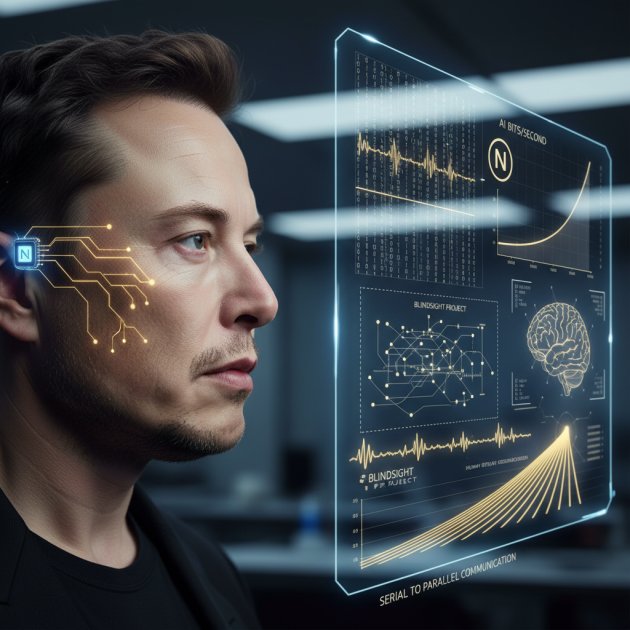
On the innovation front, where the dust of digital transformation barely settles before a new wave emerges, we are witnessing a revolution that redefines what it means to be productive, intelligent, and perhaps, human. Artificial Intelligence (AI) is no longer a distant promise; it is a palpable force, operating at a speed and scale that challenge our own biological capacity. And it is precisely at this point that Elon Musk throws out a provocation that deserves our attention: the problem is not our intelligence, but our "output bottleneck".
Think with me: you have a brilliant idea, a disruptive business plan, a creative solution to a complex problem. But to externalize it, you need to type, speak, draw, gesture. Each of these acts is a slow interface, a barrier that prevents the speed of your thought from materializing at the same cadence. While your brain processes information at astonishing speed – a true neural supercomputer – our ability to communicate that information to the world is drastically limited. It's like having a high-speed fiber optic connection to your home, but needing to use a dial-up modem to connect to the internet. The frustration is real, the potential, unexplored.
The Human Bandwidth Bottleneck: The Unexpected Disadvantage
Musk, with his vision always focused on the limits of the possible, points to a fundamental disparity that many of us have felt, but few articulate with such clarity. While a cutting-edge AI model can process and generate billions of bits of information per second, an average human, even typing furiously or speaking eloquently, rarely transmits more than 1 byte per second of useful information. This is a difference in magnitude that borders on an abyss. It is not a cognitive failure, but a strictly physical, biological limitation. Our biological hardware, however impressive in its complexity, was not designed for the age of artificial superintelligence.
This slowness not only prevents us from externalizing ideas; it also puts us at a competitive disadvantage. If you are not using technology to accelerate your game today, someone else is already using it to overtake you. And this "acceleration" is not limited to digital tools we use with our hands or voice. The real leap, in Musk's view, is in overcoming the slowest interface of all: the one between our brain and the digital world.
Neuralink: More Than Medicine, an Evolutionary Survival Strategy
When Neuralink is mentioned, most people immediately think of cures for neurological diseases, and that is a fundamental part of its mission. However, Musk's vision goes far beyond rehabilitation. He argues that artificial superintelligence is an inevitable reality, and that it will emerge regardless of our biology. In this scenario, Neuralink does not exist just to create "superhumans" in the traditional sense, but to ensure that humanity does not become a mere spectator, or worse, obsolete, in a world increasingly shaped by artificial entities.
The goal is to allow humans to communicate at the same pace as AI. Imagine no longer needing to type, or even speak, to interact with a computer, to create a design, to program an algorithm, or to share a complex idea. The brain-machine interface would allow parallel communication, directly from the mind to the system, unleashing a flow of information that is unimaginable today. This is not science fiction for the distant future; it is what is being built now, with the urgency of someone who knows that time for adaptation waits for no one.
Real Advances and Transformative Impact
What once seemed like a scene from a science fiction movie is becoming a clinical reality with firm and impressive steps. Neuralink is not just a concept; it is a company with tangible results. By early 2026, we already had reports of five human patients who received functional Neuralink implants, and the impacts are profound.
- ALS Patients: Individuals suffering from Amyotrophic Lateral Sclerosis (ALS) who have lost the ability to speak or move are now using the power of pure thought for continuous, high-bandwidth communication. Think about what this means: not just an assistive device that helps spell words, but an interface that translates complex intentions directly into commands or text, surpassing any previous technology in speed and fluidity. It is the rescue of voices that seemed lost forever, and the restoration of autonomy that seemed unattainable.
- Vision Restoration with "Blindsight": The company's next horizon is equally audacious: the "Blindsight" project. This project aims to restore vision, not only to people who have recently lost it, but even to those born blind. The idea is to completely bypass the eye or optic nerve, directly stimulating the brain's visual cortex. If successful, this would represent a revolution in medicine and neurotechnology, redefining what it means to "see" and how we perceive reality. It is not just a prosthesis; it is an extension of human perception, a new sense built technologically.
These advances are not mere experiments; they are milestones that demonstrate the disruptive potential of neurotechnology. They force us to question the limits of our own biology and to imagine a future where disability can be not only mitigated, but fundamentally overcome through human-machine integration. It is proof that design and technology, when applied with audacity, can rewrite the rules of the game.
The Ethical Dilemma: The Last Frontier of Mental Privacy
Every disruptive innovation carries an ethical weight, and Neuralink's brain-machine interface is no exception. If, on the one hand, the promise of unlocking our cognitive potential and overcoming physical limitations is seductive, on the other, a deep debate arises about privacy. The brain is, for many, our last citadel of privacy, the sanctuary of the most intimate thoughts, of unexpressed emotions. With a direct interface, the inevitable question is: who will audit or oversee what is read by these chips?
This is not a trivial matter. The security of our digital data is already a gigantic challenge; imagine the security of our mental data. How do we ensure that our thoughts, our memories, and our intentions remain under our control? It is a fertile ground for reflection by designers, legislators, and society as a whole. We need robust ethical frameworks that evolve at the same speed as technology, ensuring that progress does not sacrifice the essence of our humanity.
There are non-invasive alternatives, such as haptic gloves, augmented reality glasses with eye tracking, or muscle sensors that we already see in advanced prototypes. However, Musk argues, and rightly so, that none of them solve the real problem of the "output bottleneck," as they still rely on the slowness and limitation of muscles or eyes. They are incremental improvements, not the broadband revolution he proposes. The question is whether we are willing to face the discomfort of a radical solution to an existential problem.
Speed Does Not Wait for Consensus: A Call to Action
Elon Musk's vision is, above all, pragmatic and, for some, frightening: AI will not slow down to wait for us. Therefore, it is we, humans, who need to evolve, to adapt. The feeling of obsolescence that many professionals and companies feel today when trying to keep pace with AI tools is just the prelude to a much larger interface shock. It is not a question of whether the technology will be possible, but of who will be willing to accept it and who will risk being left behind.
If you are a creator, an innovator, a business leader, the reflection here is profound. How are you preparing for an era where communication and interaction can transcend biological barriers? How does your product design, your innovation strategy, and your own productivity fit into this future? The truth is that adaptability has never been so crucial. It's not about embracing a brain chip tomorrow, but about understanding the direction of the current and starting to row. Innovation is not an option; it is a survival strategy.
The digital future does not wait for consensus. It unfolds at a speed that challenges our conventions. The question is not whether you will use a neural chip, but whether you are ready to operate in a world where the mind connects to the machine with the same fluidity with which we think today. The guy who simplifies the future and shows how to use technology to create a competitive advantage provokes you: what will you do to accelerate your game and ensure your mind is ahead, and not just following, the pace of innovation?