
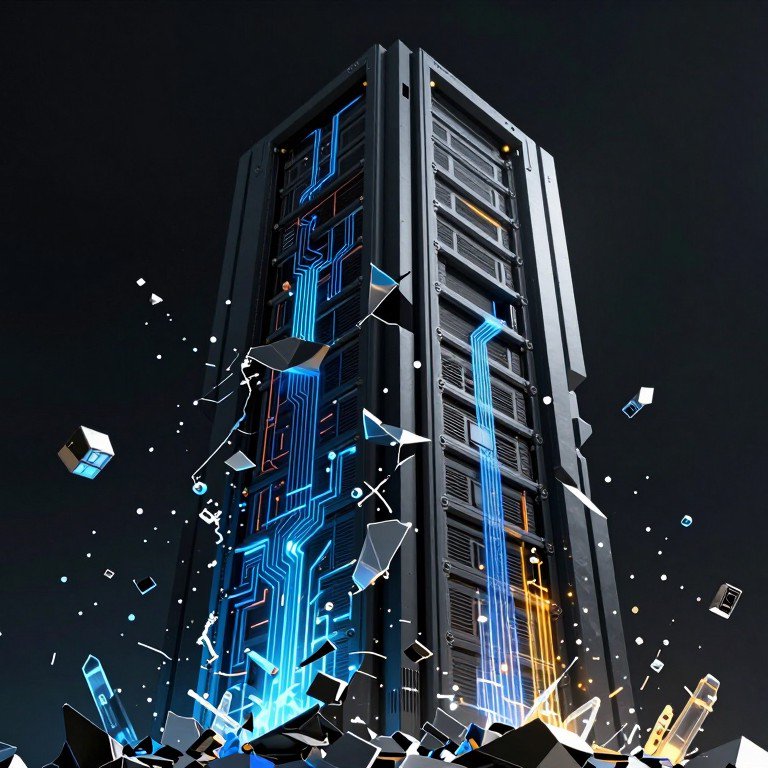
Imagine arriving at the office—or opening your laptop at home—only to find your "digital brain" has vanished. No emails, no chats, no access to shared documents, and worse, no AI to automate 70% of your daily tasks. This is exactly what happened during the recent global Microsoft 365 outage. In minutes, businesses worldwide were sent back to the digital Stone Age.
As a professional at the intersection of design and technology, I see AI as our generation's greatest productivity lever. However, there is a fine line between using technology to scale and handing the keys to your business to a single service provider. If you lack a Plan B, you don't have a business; you have a dependency.
The Danger of Centralization: When the "Copilot" Becomes a "Passenger"
Centralization brings efficiency but creates a "single point of failure." When we house our entire operational intelligence within one ecosystem, we bet that it will never fail. According to BleepingComputer, the recent Microsoft outage caused more than technical paralysis; it caused behavioral paralysis. Teams stopped working because they didn't know how to operate without integrated tools.
The problem isn't AI; it's our operational atrophy. When we outsource critical thinking to a tool, we forget how the process works without it. Technology should be an acceleration layer, not the foundation of your workflow.
Diversification: The New Golden Rule of Resilience
I am not suggesting you uninstall your AI tools. I am suggesting you apply the concept of resilient system design. In software development, redundancy is key. If one node fails, the system keeps running.
How to apply this to your business:
- Agnostic Stack: Don't centralize all intelligence in one suite. If you use Copilot, have alternative workflows running on open-source models (like Llama or Mistral) on local servers.
- Offline Documentation: If your project depends on a cloud tool, do you have a backup of the process logic? Can you execute your core service offline?
- Hybrid Processes: Identify critical tasks. If AI goes down, can you maintain the flow manually for 24 hours? If not, you have a severe operational risk.
Lessons from Those Building the Future
The market is shifting. We see discussions about giants like NVIDIA being "too big to fail" and hardware shortages due to AI demand. This volatility is a sign that infrastructure is fragile.
Those who don't know how to use AI will fall behind. But those who use AI while knowing it is a tool, not the strategy, will remain standing when the system fails.
Reflection for Your Next Step
Look at your workflow today. If your main platform went down, what would remain? Innovation requires boldness, but sustainability requires resilience. Your challenge this week: design an "analog" or "independent" contingency plan for one critical process. Don't wait for the next outage to discover your productivity is actually a fragility disguised as convenience.