
The market is no longer debating whether Artificial Intelligence is useful; that phase is over. Now the game is about who can implement AI deeply and strategically at the core of operations. If you still see AI as just a chat tool for quick questions, I’m sorry to say it, but you’re leaving money and efficiency on the table. The real competitive leap happens when we stop “playing” with prompts and start building autonomous systems that solve complex problems without constant supervision.
Many companies try to skip steps and end up frustrated with superficial results. They buy expensive licenses, but they don’t change the architecture of work. To create automation that truly moves the business needle, we need a solid structure. This isn’t magic—it’s engineering and strategic vision. I break this process into three non-negotiable pillars that turn an ordinary company into a data-driven performance machine.
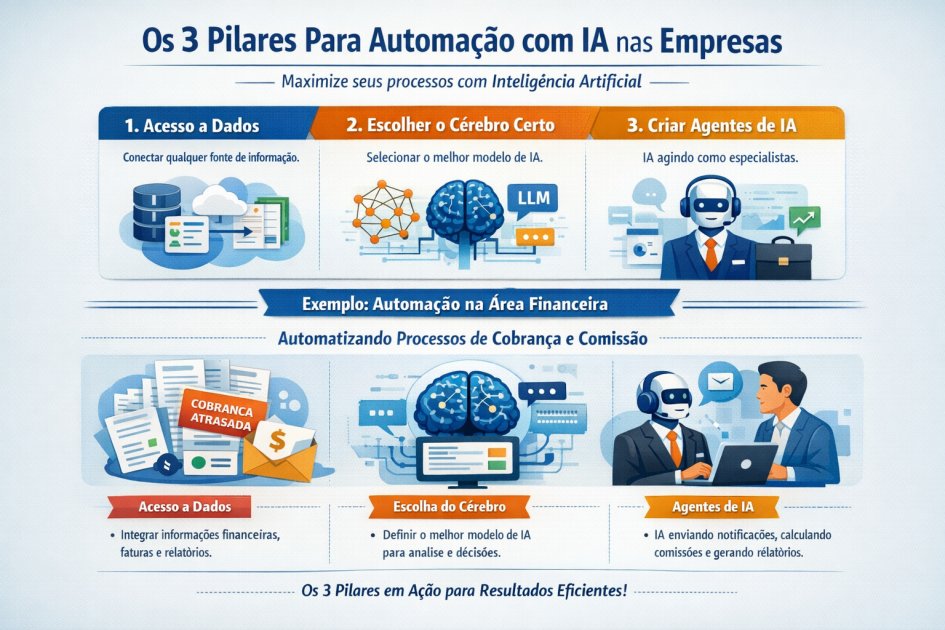
Pillar 1: The Fuel – Unrestricted, High-Quality Access to Data
No intelligence, no matter how advanced, works in a vacuum. The first major bottleneck for companies is information isolation. Data is trapped in silos: some in the ERP, some in the CRM, another portion in lost spreadsheets, and the rest in invoice PDFs. For AI automation to be effective, it must be able to access and interpret any type of data, structured or unstructured.
According to studies published on Towards Data Science, about 80% of corporate data is unstructured (emails, documents, audio). Ignoring this mass of information is like trying to fly a jet with an almost empty tank. Modern automation requires robust connectors and APIs that allow AI to “read” the company’s context in real time. Without that access, AI is just a theoretical consultant that doesn’t know the reality of your operation.
Therefore, the first step is internal data democratization for the automation tool. We need to ensure AI can query sales history, check inventory, and read the customer contract simultaneously. When data flows without barriers into the AI system, we eliminate human interpretation errors and give the digital “brain” the raw material it needs to make decisions based on facts, not assumptions.
Pillar 2: The Brain – Choosing the Right Language Model (LLM)
A classic mistake is believing there’s a single AI model that solves everything. On the innovation front, we know that choosing the right “brain” for each situation is what separates amateurs from high-performance professionals. You wouldn’t use a cannon to kill a fly, nor a simple calculator to forecast the financial market. Each Large Language Model (LLM) has specific strengths, costs, and latencies.
For tasks that require extreme logical reasoning and multimodal capabilities, models like GPT-4o or Claude 3.5 Sonnet are unbeatable. For high-scale repetitive tasks where speed and cost are crucial, smaller and more agile models—like Llama 3 or Gemini Flash—can be the strategic choice. The secret of modern automation architecture is orchestration: knowing which model to call for each step of the process.
"Technology is not a one-size-fits-all solution; it’s an ecosystem of capabilities that must be combined with surgical precision to generate real value."
When designing automation, I analyze task complexity. If the goal is simply to summarize a straightforward text, we use an efficient, low-cost model. If the goal is to analyze ambiguous contract clauses and cross-check them with current laws, we invest in the model with greater cognitive processing capacity. This smart choice ensures automation is financially sustainable and technically superior.
Pillar 3: The Agent – AI as a Specialized Collaborator
This is where the magic really happens. Forget the idea of AI that only answers questions. We are in the era of AI Agents. An agent is not just a chatbot; it’s an entity configured with tools, memory, and autonomy to execute tasks end-to-end. It’s like hiring a highly trained digital professional for a specific role.
Unlike traditional “if this, then that” (IFTTT) automation, agents have judgment. They can decide which tool to use, when to seek more information, and how to respond to an unexpected event. If you configure an agent to manage leads, it won’t just send a standard email; it will analyze the customer’s LinkedIn profile, check interaction history, and draft a personalized proposal—adjusting tone of voice as needed.
As we often see in discussions in communities like GitHub and UX Collective, agent design focuses on “agency.” That means giving the system the power to act on the world. Those who don’t learn to create and manage these AI agents in their workflows will quickly be overtaken by those already operating with a hybrid workforce—where humans focus on strategy and agents focus on flawless execution.
Real Scenario: Revolutionizing the Finance Department
To take this out of theory, let’s look at one of the most traditional and bureaucratic areas: Finance. Imagine a company that works with hundreds of sales reps and needs to perform data cross-checking for commission payments and collections from delinquent customers. Manually, this is a spreadsheet-and-reconciliation nightmare that takes weeks.
Applying the three pillars, the transformation is dramatic:
- Pillar 1 (Data): We connect AI directly to the bank statement via API, to the sales CRM, and to the invoicing system. AI can now “see” who sold, who paid, and who is overdue in real time.
- Pillar 2 (Brain): We use a high-reasoning model to analyze complex commission contracts, which may vary by product, margin, or region. AI understands exceptions that ordinary automation would ignore.
- Pillar 3 (Agent): We create the “Reconciliation and Collections Agent.” It identifies that Customer X hasn’t paid, checks whether there was any payment promise in the email history, calculates the penalty, and sends a personalized WhatsApp notification—already offering a renegotiation link based on company rules.
The result? What used to take 10 days of human work is now done in minutes, with zero errors and a level of proactivity the human team would hardly achieve without stress. The finance professional wasn’t replaced; they were elevated to the role of auditor and strategist, focusing on optimizing cash flow while AI handles the repetitive heavy lifting.
Conclusion: The Next Step Is Yours
AI automation isn’t about the future; it’s about survival in the present. If you look at your company’s processes and still see people copying data from one place to another, you have a golden opportunity—or an imminent risk. The technology to create this competitive advantage is already available and more accessible than ever.
My challenge to you is: pick one process today. The one that drains your team’s energy and seems impossible to automate because of “human complexity.” Apply the three pillars. Ensure data access, choose the right model, and design the agent that would do the job. The digital future doesn’t wait for those who are comfortable. It belongs to those who have the courage to simplify chaos through innovation.
So, will you keep operating manually, or will you build the intelligence that will scale your business?