
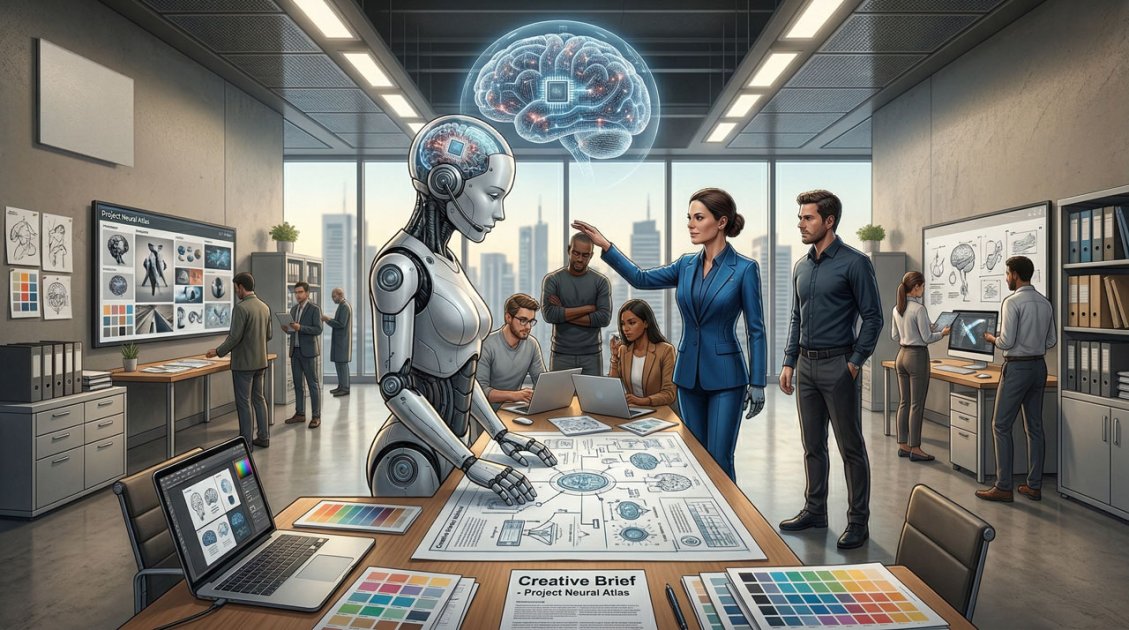
We are living in an era where technical efficiency has reached a frightening level. If you need an image, a text, or a line of code, Artificial Intelligence delivers it in seconds, with a competence that, five years ago, we considered impossible. However, the closer AI gets to technical perfection, the more we perceive a void: the lack of something that cannot be programmed. The question that refuses to be silenced is no longer "what can AI do?", but rather "what is left for us when the machine does everything perfectly?".
The answer lies in a concept that many professionals neglect: vulnerability as a competitive differentiator. In a recent reflection on the impact of technology on art and creative production, we observed that AI dominates the field of white noise, low-emotional-load entertainment, and mechanical tasks. But it fails miserably when it comes to deep connection. We connect with an artist's work not by the perfection of the strokes, but by the weight of the experience they "paid for". When Eric Clapton composes about a personal tragedy, the music resonates because we know that pain is real, lived, and processed by a human being. AI can simulate the melody, but it will never be able to feel grief.
The danger of "Digital Drugs" and the dictatorship of the algorithm
We cannot talk about productivity without looking at the ecosystem where we spend most of our time. Social networks, shaped by engagement algorithms, often function as digital drugs, designed to keep the user in an altered state of consciousness, focused on infinite consumption. It is a gross mistake to believe in the neutrality of these systems. The algorithm carries the ethics of those who programmed it, and that ethics, most of the time, prioritizes profit and retention over human well-being.
This influence goes far beyond suggesting the next cooking video. It is shaping behaviors, defining social circles and, in extreme cases, dictating the destiny of interpersonal relationships. If you hand over the curation of your reality to the algorithm, you stop being the protagonist of your life to become a variable in a Big Tech business model. Technology should be a tool for expansion, not a cognitive prison that limits your perception of what is real and valuable.
AI in the studio: Technology as a lever, not a substitute. For now!
On the innovation front, I see many professionals trying to delegate their own creativity to AI. This is a strategic error. The correct way to face this change is to use the machine to accelerate the process, not to replace the intention. In top studios, AI is used as a tool for research and rapid prototyping. We can mix complex visual references — such as fusing the aesthetics of Arab architecture with indigenous elements — to generate initial concepts in seconds. This saves hours of searching and brainstorming, allowing the human to focus on what really matters: curation and final finishing. For now!
The limit of this delegation is clear: creative sovereignty. If you allow AI to write your scripts or define the soul of your characters, you are outsourcing the pleasure of "doing". The creative process is where the magic happens, where human neural connections solve problems that the statistical logic of language models ignores. Those who do not know how to integrate AI as a luxury assistant to gain scale will certainly be left behind. But those who forget that the final voice must be human will lose the only thing that makes them irreplaceable: their identity.
Responsibility and the future of innovation
We need to stop throwing responsibility onto technology. AI does not make decisions on its own "For now"; it operates within the parameters we define. When something goes wrong, it is not a "system failure", it is the failure of the operator who did not know how to guide the tool. We need to regain control over the ethics of our work and how technology impacts the society we build.
"Technology is an extension of our capacity, but it should never be a substitute for our humanity. The future belongs to those who use the machine to raise the level of art, and not to dilute it."
The invitation here is for immediate reflection: where, in your current work process, are you just a machine operator and where are you an author? If most of your day is composed of tasks that an AI could do, you are in danger. Not because AI will replace you, but because you are wasting your unique human capacity on tasks that do not require your soul.
Act now: Choose a repetitive task that you do today and automate it with AI this week. Use the time you gained to deepen your own voice, invest in an authorial project or improve the quality of connection with your audience. The future is not about who has the best technology; it is about who has the best technology and the courage to be human in the process. Innovation is waiting for you. What will you create today that a machine would never be able to feel?