
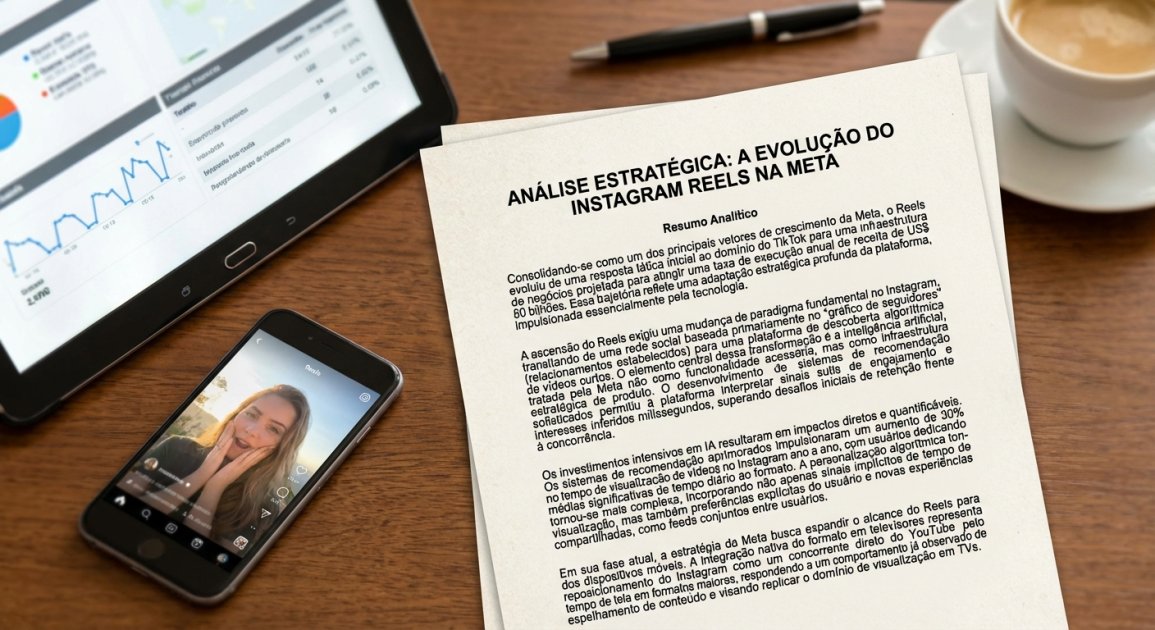
Have you ever wondered how tech giants manage not only to react to a competitive threat but to transform it into a powerful growth lever? The story of Instagram Reels is not just about the rise of a video format; it's a masterclass in strategic adaptation, purpose redefinition, and, above all, the relentless application of artificial intelligence as a core product infrastructure.
In today's digital world, where attention is the most valuable currency, standing still is the same as falling behind. Instagram, a platform that thrived for years on connecting friends and sharing photos, found itself facing a colossal challenge: the meteoric success of TikTok. The problem was real and palpable: a new generation of users was migrating to a radically different content experience, focused on algorithmic discovery and short-form video. If you're not using technology to accelerate your game today, someone else is already using it to overtake you. And that's exactly what Meta realized.
The Strategic Response: From Clone to Growth Engine
Reels indeed started as an urgent and, frankly, somewhat rushed response to TikTok's viral dominance. Launched in 2020, early indicators were far from encouraging. Internal Meta data, revealed in analyses such as those by The Wall Street Journal, showed that in 2022, the time users spent on Reels was only a tenth of what they spent on TikTok. This wasn't just a warning sign; it was a battle cry. A transformative insight was needed to turn the tide.
The crucial realization came from Instagram's VP of Product, Tessa Lyons, who pointed out the need to redefine the platform's fundamental purpose. The original Instagram was a "follower graph," a network where content was ranked based on who you knew. TikTok, on the other hand, was a "discovery" engine, where videos were suggested based on watch time and inferred interests, regardless of whether you followed the creator. This was an abyssal difference, and the ability to make this transition would be the game-changer.
Artificial Intelligence as the Heart of Discovery
Here enters the true catalyst for transformation: artificial intelligence. For Instagram, AI was not a passing trend but the indispensable strategic product infrastructure for its survival and growth. Mark Zuckerberg, in Meta's earnings calls, has been explicit: Reels' exponential growth is directly attributed to "AI-powered content recommendation systems," which deliver "higher quality and more relevant content" to users. This is not a detail; it is the core of the strategy.
Building this recommendation infrastructure required Meta to develop much more sophisticated AI systems. They needed to be able to interpret subtle engagement signals – such as the time you spend watching a video, whether you share it, pause it, or go back to rewatch it – and do so in milliseconds. It's a complex orchestra of algorithms working incessantly to map your interests, even those you haven't explicitly expressed. This predictive and personalization capability is what differentiates a reactive platform from one that shapes the future of user experience.
The Algorithmic Discovery Paradigm and Its Impacts
Instagram's shift from a follower-based social network to an algorithmic discovery platform had direct and measurable impacts. Firstly, on engagement: the time people spend watching videos on Instagram increased 30% year-over-year, a figure that highlights the effectiveness of the new approach. This increase is not accidental; it is the direct result of the relevance that AI can deliver.
In terms of usage time, the turnaround is remarkable. According to market intelligence firm Sensor Tower, the average Instagram user now dedicates 27 minutes per day watching Reels. To put it in perspective, YouTube Shorts viewers spend about 21 minutes, while TikTok still leads in its main feed with 44 minutes. But the race is tight, and Meta is showing it can compete head-to-head. And most impressively: Reels, across the entire Meta ecosystem (Instagram and Facebook), surpassed an annual run rate of $50 billion, as revealed by Zuckerberg in October. This places it at a revenue level comparable to giants like Coca-Cola or Nike, and narrows the gap with YouTube, which analysts expect to generate $46 billion in ads this year. TikTok, for comparison, projects about $17 billion in the same period, according to eMarketer. The numbers don't lie: AI is not an expense; it's an investment with brutal returns.
Expanding Horizons: Reels for Larger Screens and the Challenge to YouTube
But Meta's ambition doesn't stop at the smartphone. The company is expanding Reels' reach to larger screens, such as televisions. It has already begun testing Instagram for TV, with a limited launch on Amazon Fire TV devices in the US. This move is a clear strategic repositioning of Instagram against YouTube, which has long dominated video consumption on TVs. Meta's internal research showed that many users were already mirroring their phones to watch Reels on TV, which motivated the formalization of this experience.
This expansion is more than a convenience; it's a declaration of war for user attention across all devices. TV video consumption already surpasses YouTube's mobile traffic, a scenario Instagram seeks to replicate. For those who create content or manage a brand, the question is: is your video strategy ready to be consumed in different formats and screen sizes? Adaptability is the key to the future.
Advanced Algorithmic Personalization: The Next Level of Experience
The sophistication of AI in Reels goes beyond simple recommendation. Meta is constantly refining how users interact with the video feed, seeking increasingly granular personalization. An example of this is the "Blend" feature, launched in April, which allows friends to merge their individual algorithms to create a shared video feed. This is user-centered design, applying AI to enrich social experiences in innovative ways.
Furthermore, new controls allow viewers to guide the algorithm more explicitly, specifying what they want to see – or avoid – through feedback categories like "more puppies" or "fewer gender reveal parties gone wrong." This advanced personalization not only increases engagement but also empowers the user, making the experience more relevant and less passive. Tessa Lyons confirmed that these personalization functionalities will be extended to the TV experience, ensuring that content is always appropriate, regardless of who is watching.
The Call to Action for the Digital Future
The Instagram Reels journey is a powerful case study on how AI-driven innovation can redefine the destiny of a product and an entire company. It's not just about copying a competitor but understanding the essence of what made it successful and then building a superior technological infrastructure to surpass it. Artificial intelligence, in this context, is not a buzzword but the strategic engine that enables this continuous reinvention.
Think about it: if a giant like Meta needed to redefine its game, invest heavily in AI, and change its fundamental paradigm to remain relevant and profitable, what does that mean for your business? Are you just reacting to trends, or are you proactively using technology and creativity to create a lasting competitive advantage? Those who fail to strategically apply AI in their work and products risk being left behind, watching the competition accelerate. The future doesn't wait. The question is: are you ready to build it?