
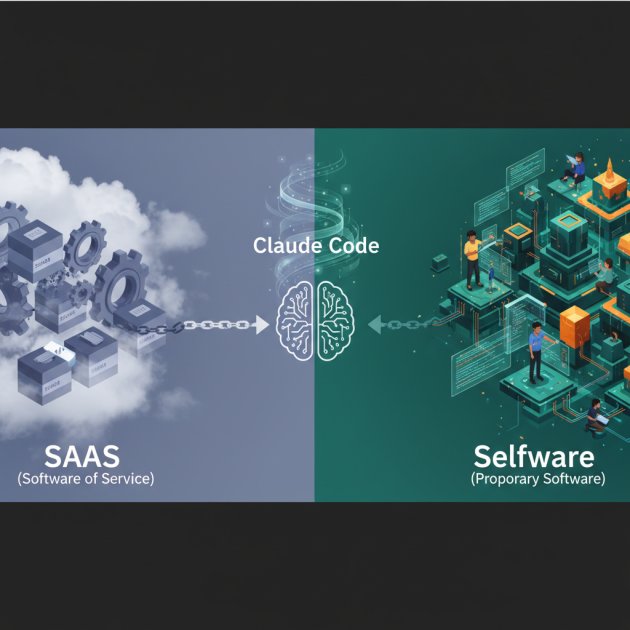
For years, we were conditioned to believe that the only way to access cutting-edge tools was to rent them. The promise of SaaS (Software as a Service) brought convenience, but at the cost of continuous dependence and often generic solutions that deliver only part of what a business truly needs. I say this with the authority of someone who maintains an active SaaS in the market, but who also develops proprietary and specific applications for large operations: the market is not simply disappearing; it is evolving. The 'rental' mindset is being challenged by technological sovereignty. Today, AI allows companies to stop being hostages to increasing monthly fees and instead become owners of solutions that solve 100% of their pain. The wheel of innovation continues to turn, but the fuel is now autonomy and extreme personalization.
The End of the Recurrence Era: AI as an Execution Agent
We are witnessing a seismic shift. Software giants, once unshakeable, are beginning to feel the ground tremble beneath their feet. The market value of many SaaS companies already reflects a brutal reality: Artificial Intelligence's ability to generate executable and functional code is redefining the game. We are no longer talking about a distant future; we are talking about today. AI, once seen as a mere "chat assistant" for answering questions or generating ideas, has evolved into an autonomous "execution agent." This means it not only writes the code but also operates it directly in the terminal, tests, debugs, and optimizes, all on its own.
Think about it: an AI agent like Claude Code, or other advanced platforms, is not just a productivity tool; it's a miniature software factory. It receives a clear problem description, understands the necessary architecture, and begins to build. Where before you would need a team of engineers for months, now a single professional, armed with the right AI, can achieve impressive results in a fraction of the time. The implication is clear: if AI can build software so efficiently, the logic of "renting" something you could own and adapt with much more autonomy simply disappears. It's only a matter of time until the cost-benefit of building your own system becomes overwhelmingly superior to subscribing to a generic service.
Selfware in Practice: Accelerated Independent Development
The rise of "Selfware" — proprietary software, custom-built with the aid of AI — is the next frontier of technological autonomy. This technology is not just for large corporations with unlimited budgets. It is empowering individual developers, freelancers, and small teams to create complex solutions that would previously be unfeasible. Imagine building a highly specialized niche marketplace, a custom project management system for your unique methodology, or even a robust auditing system, all in a fraction of the time and cost it would have taken just a few years ago.
What once was a project of months or years can now be completed in weeks, or even days. This is not hyperbole. With AI acting as a co-pilot that not only writes the code but also understands the context and intent, the barrier to entry for creating sophisticated software has collapsed. We are talking about functional prototypes, robust back-end systems, and intuitive user interfaces that come to life with astonishing speed. The power to conceive an idea and see it materialized into executable code in record time is the new superpower of innovators.
The Use Case: Health and Auditing – Where Sovereignty is Critical
In high-compliance environments, such as the healthcare sector, the ability to create proprietary solutions is not just an advantage; it is a critical necessity. Think of large hospitals or clinic networks that need to manage massive volumes of sensitive data and follow strict regulations. A claims auditing system, for example, that processes and verifies complex medical invoices, needs to be intrinsically secure, accurate, and adherent to specific business rules that can vary from state to state, or from one health insurer to another. According to an Accenture report (2023) on digital transformation in healthcare, system customization is crucial for compliance and operational efficiency in this sector.
Relying on a generic SaaS platform to handle claims auditing is a risk many can no longer afford to take. These platforms, however robust, are built for a broad audience, meaning they may not meet all the regulatory nuances or internal policies of a specific hospital. With Selfware, a claims auditing system can be built from scratch, incorporating exactly the business rules, security standards, and data privacy requirements that the institution demands, without compromise. This not only ensures data security and integrity but also surgically optimizes processes, eliminating waste and increasing accuracy, something a "ready-made" software would hardly be able to replicate with the same efficiency.
The Shift in Business Logic: From Code to Architecture
The truth is that the cost of software creation has fallen so much that the logic of "buying off-the-shelf" is becoming obsolete. Why pay a fortune for a generic license, with functionalities you don't use and limitations that hinder you, when you can build something custom-made that perfectly fits your operations, and at a potentially lower total cost of ownership in the long run? AI has democratized the ability to develop, reversing the balance of power.
In this new scenario, the professional's superpower is no longer code syntax. It's not about knowing every line of Python or JavaScript by heart. The new differentiator, the skill that truly matters, is clarity in problem description and mastery in solution architecture. It is the ability to deeply understand what needs to be solved, design the logical structure, and precisely instruct AI to materialize that vision. Those who can articulate complex problems in simple terms and create efficient solution blueprints are the ones who will lead. Those who cannot guide AI, who lack this strategic vision, run the real risk of being left behind. Because while you're thinking about buying, someone else is already building and testing.
Conclusion: The Sovereignty of Selfware and Agility as a Differentiator
"Selfware" is not just a trend; it's a return to technological sovereignty. It puts the power to build and adapt tools back into the hands of those who truly understand the problem, who live the pain and clearly see the solution. You are no longer limited by the choices of a SaaS company; you are the architect of your own digital future.