
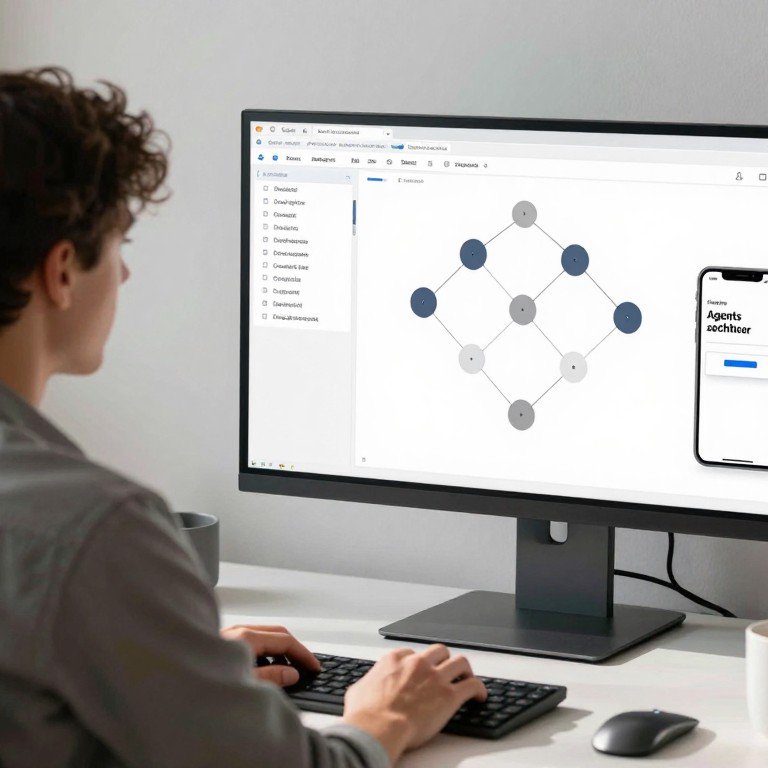
Have you ever stopped to think that, for the first time in history, your "end user" might not be a person? For decades, design has been guided by empathy: understanding human pain points, desires, cognitive limitations, and creating interfaces that make life easier for those on the other side of the screen. But the game is changing. With the rise of AI agents, we are entering an era where we also need to design for autonomous entities that make decisions on our behalf. If you still think design is just about "making things pretty," pay attention: someone is already using information architecture to have an AI agent buy the perfect Christmas gift while you sleep.
In this article, we will break down a trend that is not just hype but a structural shift in the market. We will discuss what it means to design for the "agent customer," how AI's probabilistic uncertainty can be your ally, and why choosing the right modality (text, voice, image) is the difference between success and failure for a digital product. Get ready, because the future is likely to migrate from screens to intentions.
The New Customer is an Agent: The Era of Design for Machines
When we read about Walmart teaming up with Meta to bring Black Friday deals to the AI agent Muse, we are not just talking about a marketing partnership. We are talking about a fundamental shift in the purchase journey. Muse is not a human browsing a website; it is a generative AI that understands an intent and executes an action. Interface design ceases to be a click funnel and becomes a communication protocol between agents.
The concept of "Designing for the AI agent customer" is a game-changer. Imagine you are a product manager. Traditionally, you design a website with big buttons, eye-catching colors, and persuasive copy. Now, you need to ensure that an AI agent can read your catalog data, understand exchange policies, and execute the purchase without errors. Design must be semantically rich and structured for APIs. The agent doesn't care about the beauty of the gradient on the button; it cares about the clarity of the JSON and the reliability of the information.
"Design for agents is not about graphical interface, it's about decision architecture. You are creating an instruction manual for a customer who never sleeps and never forgets."
This demands a reinvention of the UX professional. It's no longer enough to test with humans; we need to test with language models. How does your system react when an AI agent tries to make a bulk purchase? What if it misinterprets a promotion? Interaction design now includes creating safety limits and business rules that are understandable to both humans and machines. Those who do not prepare their digital ecosystem to receive these agents risk becoming invisible in the market.
The Intelligence of Uncertainty: Probabilistic Thinking in Design
We humans have been trained for determinism. If I click button "X," I expect action "Y" to happen. Traditional software design is based on Boolean logic: true or false, works or breaks. But AI brings a new layer: probability. The article "Designing With Uncertainty: How AI Supercharges Probabilistic Thinking" challenges us to embrace the "maybe."
When you design an experience with AI, you are not designing a single outcome but a spectrum of possibilities. AI can hallucinate, be too creative, or too conservative. Modern design needs guardrails and feedback systems that manage this uncertainty. Instead of fearing error, the designer should design for error recovery. How does the interface behave when the AI is unsure? Does it ask the human for help? Does it offer options?
This is what I call "probabilistic design": an approach where, instead of rigid flows, we create systems that adapt to different degrees of certainty. Think of a writing assistant. If it suggests a sentence, the probability of being correct is 80%. The interface design should show this subtly, perhaps with an option to "regenerate" or "edit." The professional who masters this logic does not fear AI; they use it to create more resilient and adaptable products. Uncertainty is not a bug; it is a feature that, when well designed, builds trust.
Modality and Intent: The Right Interface for the Right Context
Not every problem is solved with a chat. That is the number one mistake of those starting in the AI hype. The article "Matching AI Modality To User Intent" is surgical: the AI modality (text, voice, image, code) must match the user's intent. If I am driving, the right modality is voice. If I am analyzing a complex contract, the right modality is text with visual highlights. If I want to decorate my living room, the right modality is image generation.
Strategic design comes in here to avoid interface fatigue. We are seeing a flood of products that put a "chat" on everything, even when a form or a button would be more efficient. Generative AI is powerful, but it needs to be invisible or contextual. An AI agent that understands user intent should choose the best way to communicate. If the user just wants to "pay the bill," the agent should not open a 10-minute dialogue; it should just execute the action.
Technology without purpose is just cost. The choice of modality is a product design decision. When designing for agents, you should allow them to choose the ideal modality for the interaction. This reduces friction, increases productivity, and makes technology feel magical rather than an obstacle. The future belongs to multimodal and adaptive interfaces that change shape according to the need of the moment.
The Call to Action: Don't Be a Spectator of the Revolution
If you have read this far and thought "this is too futuristic," it is worth following the movement closely. Walmart is already doing it. Meta is already doing it. Design tools are already being updated to generate code and prototypes. The question is no longer "if" AI agents will mediate our digital interactions, but "when" they will be a relevant part of your traffic. And then, is your design ready to receive them?
The professional who does not know how to apply AI in their work—whether by creating interfaces for agents, using probabilistic thinking to manage uncertainty, or choosing the right modality—risks being left behind. It is not about replacement but evolution. The designer of the future is an architect of decision systems, a curator of probabilities, and a translator of human intentions for machines.
So, I leave you with an analytical invitation: take the last project you designed and ask yourself: "If an AI agent were my user, could it navigate here without stumbling?" If the answer is "no," you already know where to start. And, like any good AI experience, the future is not a certainty—it is a probabilistic bet decided by design, strategy, and, of course, a lot of technology.