
In the current landscape, creativity faces a fascinating paradox: technology, once a barrier, is now the engine of our expression. If you're still thinking about audiovisual production through the lens of the past, I regret to inform you: the game has changed. The question is no longer how to do it, but rather what to create. Artificial intelligence tools are not just optimizing processes; they are redefining what's possible, democratizing access to a level of production previously reserved for large studios.
This is the thesis I've been advocating, and it materializes with every new tool launched on the market. Film production, once a universe of astronomical budgets and gigantic teams, is becoming accessible to anyone with a good idea and mastery of the new "cognitive prostheses" that AI offers us. The technical barrier to delivering high-fidelity video, with complex movement and rich details, has simply collapsed. Now, the true currency is the creator's vision, intentionality, and curation.
The New Audiovisual Production Paradigm: From "How" to "What"
For a long time, the audiovisual industry was defined by its technical bottlenecks. Expensive cameras, complex software, countless hours of rendering, and a multidisciplinary team were prerequisites for any ambitious project. This created a gigantic gap between a brilliant idea and its execution, limiting who could tell stories with a certain level of visual and narrative quality.
Today, this scenario is turning upside down. The democratization of filmmaking is no longer a distant promise; it's a tangible reality. Generative AI tools, such as next-generation video models, are allowing individuals and small teams to produce content that rivals what previously required Hollywood infrastructure. The focus shifts radically: it's no longer about mastering every button of a software or having access to an expensive studio, but about having a clear vision, an engaging story, and the ability to orchestrate AI to manifest that vision. Those who fail to apply this new reality to their work risk being left behind, seeing their ideas surpassed by those already riding this wave.
Case Study: AI Music Video - "A Poeira" – An Innovation Lab in Action
For me, it's not enough to talk about the future; it's necessary to build and experience it. It was with this mindset that I embarked on the project "AI Music Video - A Poeira," a practical case study that served as a validation laboratory for this new era of audiovisual production. My goal was clear: to test the limits of available AI tools to create a complete music video, from concept to final edit, in record time. The result? A project that encapsulates the essence of innovation and productivity.
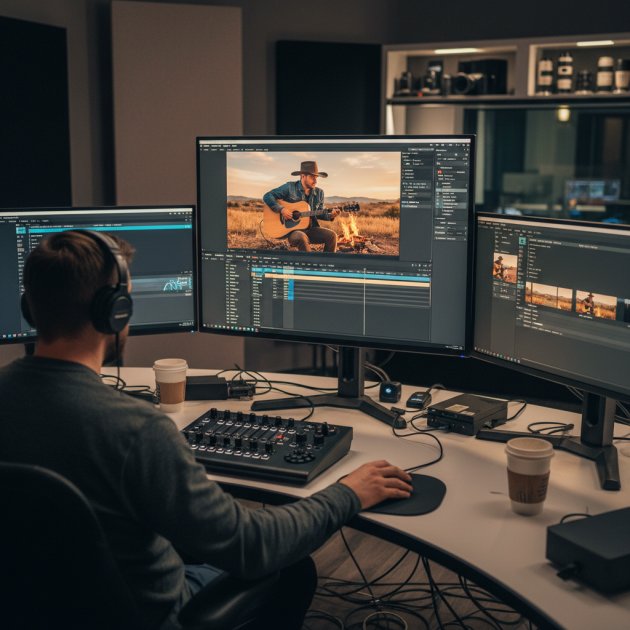
The pipeline I developed for "A Poeira" was a hybrid of human creativity and intelligent automation. I started with the lyrics, which were generated and refined with the help of GPT-5, exploring nuances and narratives that fit my vision. Next, the melody and musical arrangement were created using Suno AI, a tool that allowed me to experiment with different styles and instrumentations until I found the perfect sound for the emotion I wanted to convey, with an engaging country touch. The visual part began with the generation of static images in Midjourney, where I could explore visual and aesthetic concepts that would serve as the basis for the animation. The big breakthrough came with the animation of these images, where I used Google's Veo3 to bring the frames to life, transforming static illustrations into dynamic and fluid sequences. Finally, all this raw material was orchestrated and edited in DaVinci Resolve, where I added the final touches of color grading, transitions, and synchronization, polishing the raw material into a cohesive and impactful piece.
The most impressive part of this entire process was the time. A project with this complexity and level of detail, which would traditionally take weeks or even months for a conventional team to complete, was finalized in just two days. This is not a trick; it's the power of AI in action, multiplying the capacity of a single creator and allowing intuition and vision to become the driving force, rather than technical impediments.
Exponential Evolution: The Quality Leap Has Arrived
It is fundamental to understand that AI is not static; it is a "cognitive prosthesis" that evolves at a dizzying pace, weekly, if not daily. Although "A Poeira" was a successful pilot and a personal milestone in my journey of AI exploration, the new generation tools that are emerging – such as Sora itself and other advanced video models – allow that, today, this same project can achieve a level of perfection and photorealism that was simply impossible just a few months ago. What was impressive yesterday is the starting point for tomorrow's extraordinary.
Visual quality, temporal coherence, and the ability to generate complex and long scenes with meticulous details are reaching levels that challenge perception. We are not just talking about simple animations, but entire virtual worlds, expressive characters, and visual narratives that unfold with impressive fidelity. This constant evolution validates my initial premise: the technical barrier no longer exists. Runway AI, for example, has conducted deep research on this convergence between creativity and AI, evidencing the transformative potential of these tools, as we can see in their case studies on "The Turing Reel," which explore AI's ability to generate complex and convincing visual narratives. (Source: Runway AI Research: The Turing Reel).
The Designer as Strategist: Curation and Intentionality in Command
Given such generative capacity, a crucial question arises: what is the role of the creator, the designer, the artist? The answer is clear: AI does not replace the artist; it expands their scale and elevates their role. The designer of today and the future is no longer a mere tool executor; they are a strategist, a vision director. Their expertise shifts to intentionality, to curation, and to the ability to articulate precise prompts that guide the machine in the right direction.
The machine is an incredibly powerful co-pilot, but without a pilot with a clear vision, it can go anywhere. It is human sensitivity, the understanding of cultural nuances, emotional intelligence, and the ability to tell stories that give soul to what AI generates. Human control over the machine is not about micromanaging pixels, but about the macro-strategy of the narrative, about choosing aesthetic paths, and about ensuring that the right emotion is conveyed. It is here that design becomes, more than ever, a strategy for impact and performance, transforming data and algorithms into meaningful experiences.
Conclusion: Ready to Create the Impossible?
The audiovisual revolution driven by AI is just beginning, and what we saw with "A Poeira" is just a glimpse of what's to come. The future of content production is not about waiting for millionaire budgets or huge teams; it's about empowering the creator's vision, allowing ideas to be transformed into reality with unprecedented speed and quality. If you're not using technology to accelerate your game today, someone else is already using it to surpass you. The time to experiment, to dare, and to create the impossible is now.
I invite you to delve into my project and see with your own eyes the practical application of this innovative workflow. Understand how intentionality, combined with the power of AI, can transform the way you think about and execute your ideas. The future doesn't wait; it is built by those who dare to explore it.
See the complete project here: washiviana.com/pt/projeto/clipe-ia-a-poeira