
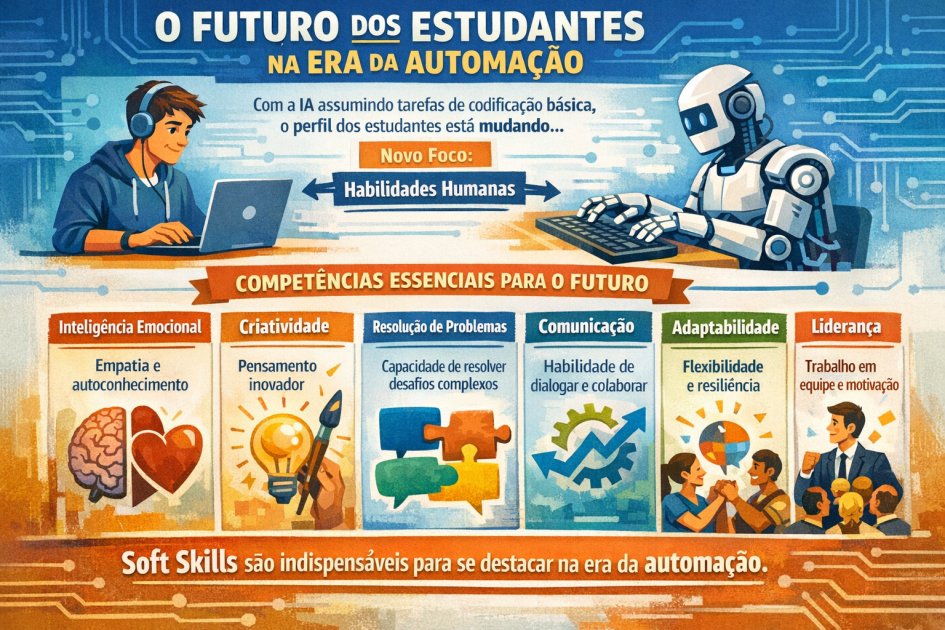
Let’s be direct: the fear isn’t that Artificial Intelligence will come to steal your job. The real fear—the true crossroads—is that those who don’t know how to use AI to supercharge their own work, to level up their game, are the ones facing a monumental risk. We’re living through a metamorphosis in the job market, where automation is advancing into tasks that used to be exclusive to so-called “white-collar” roles and even basic coding—and it’s shaking the foundations of education and careers like never before.
Think about it: AI is already writing lines of code, generating complex reports, and even analyzing data at speeds and scales no human could achieve alone. This isn’t science fiction—it’s our always-on reality. This shift is forcing a deep reassessment of what it means to be a valuable professional. It’s no longer about executing repetitive tasks perfectly, but about navigating complexity, innovating, and connecting dots the machine can’t see. It’s an invitation to go beyond the obvious.
The problem, then, is clear: if machines are taking over operations, what’s left for us? What makes you, as a professional, indispensable? That’s the question echoing in the classrooms of the most forward-thinking universities and in the hallways of companies setting the pace of innovation. Many feel lost, unsure where to focus their efforts, investing in skills that may become obsolete in just a few years. Uncertainty hangs in the air, and the sense of racing against time is palpable for many of you.
The Transformational Insight: Your Humanity Is the New Strong Currency
Here’s the key insight that can change your trajectory: the real competitive advantage in the future won’t be your isolated technical hard skills, but your ability to leverage AI with a robust set of inherently human abilities. We’re talking about your soft skills—those that machines still can’t replicate authentically. Your curiosity, your empathy, your ability to build meaningful connections, and your non-linear problem-solving are what will make the difference.
Today’s students—and professionals of all ages—are starting to realize this. The profile of the “ideal student” is changing dramatically. It’s not enough to be a programming genius; you need to be a critical thinker, an effective communicator, a creative problem solver. Research from the World Economic Forum, for example, consistently highlights skills like analytical thinking, innovation, complex problem-solving, and creativity as the most in-demand for the next decade. This isn’t a guess—it’s a map to the future of work.
Technology pushes us to be more human, paradoxically. It frees us from mechanical tasks so we can focus on what truly matters: strategy, innovation, connection, emotion. It’s time to stop competing with the machine on its turf and start playing on your own field, where creativity and emotional intelligence are your greatest assets. If you’re not cultivating these skills now, AI won’t replace you—but someone who has them and knows how to use AI to amplify them will leave you behind.
Practical Solutions: Building the Essential Skills for Tomorrow
So how do you prepare for this new landscape? The answer lies in an intentional approach to personal and professional development, focusing on the soft skills AI can’t automate. It’s not an easy path, but it’s the most strategic one. Let’s demystify it and outline practical steps for each:
1. Critical Thinking and Complex Problem Solving
- Why it’s essential: AI can process data and identify patterns, but interpreting nuance, questioning assumptions, and crafting solutions for problems without a clear “right” or “wrong” is human. It’s the ability to see beyond the algorithm.
- How to develop it: Engage in debates, read different perspectives, break complex problems into smaller parts, and question the “why” behind everything. Practice scenario-based decision-making, not just data-driven choices. Seek challenges that require more than a standard answer.
2. Creativity and Innovation
- Why it’s essential: AI can generate variations on an existing theme, but the spark of a truly original idea—the ability to connect disparate concepts to create something entirely new—is the essence of human innovation. It’s the ability to dream the impossible and make it real.
- How to develop it: Make time for activities that stimulate imagination: art, music, creative writing, free-form brainstorming. Explore new fields of knowledge, even if they’re not directly tied to your profession. Collaborate with people from different backgrounds to expose yourself to new ways of thinking.
3. Adaptability and Flexibility
- Why it’s essential: The pace of technological change is relentless. Those who can’t adapt quickly to new tools, processes, and market realities risk becoming obsolete. AI is always evolving—and you need to evolve too.
- How to develop it: Embrace continuous learning. Try new AI tools in your daily life, even playfully. Stay open to changing plans, reassessing strategies, and seeing every challenge as a learning opportunity. Step out of your comfort zone regularly.
4. Emotional Intelligence and Collaboration
- Why it’s essential: AI can simulate emotions, but it doesn’t feel them. The ability to understand and manage your own emotions—and genuinely connect with others’ emotions—is fundamental to building effective teams, leading with inspiration, and negotiating successfully. Collaboration is the key to synergy between humans and machines.
- How to develop it: Practice active listening, observe people’s reactions, and try to understand the motivations behind them. Seek constructive feedback and work on giving feedback empathetically. Join team projects, taking on different roles and learning to mediate conflicts.
5. Curiosity and Active Learning
- Why it’s essential: In a world where knowledge doubles every few years, curiosity is your engine for staying relevant. The drive to learn, explore the unknown, and seek new information is what keeps you ahead of the curve.
- How to develop it: Stay up to date on the latest trends in technology, design, and innovation. Read books and articles, attend workshops and online courses. Ask questions, explore tutorials, and experiment with new tools. Turn curiosity into a daily habit.
Technology—especially AI—is not an enemy to fight, but a tool to master. Your ability to integrate these tools with your unique human skills is what will define your success. Think of AI as a super-intelligent co-pilot: it handles technical and repetitive details, freeing you to focus on strategy, vision, and human interaction—where you truly shine. It’s a partnership, not a replacement.
“If you’re not using technology to accelerate your game today, someone already is—and they’re passing you. The future doesn’t wait; it’s built now, by the choices you make about your skills and tools.”
Call to Action: What Will You Do Today?
The age of automation isn’t a threat to those willing to evolve. It’s an invitation to become a more powerful version of yourself—a more strategic, more creative, more human professional. The question is no longer “what will AI do?”, but “what will you do with AI?”.
Don’t wait. The time to act is now. Start by assessing which of these soft skills you already have and which you need to develop. Pick one to focus on this week. Use the references I share to go deeper, find inspiration, and understand how other professionals are navigating this new landscape. Explore communities like ACG Brasil for design and 3D, UX Collective for user experience insights, or Towards Data Science to deepen your knowledge of AI and machine learning. Knowledge is available—the willingness to learn has to come from you.
Remember: the future isn’t something that happens to you; it’s something you create. And the best way to create it is by investing in yourself, in your most human capabilities, and learning to orchestrate them with the power of technology. The game has changed. Are you ready to play?